Wednesday, December 18, 2013

Resume

Professional Experience 

Development QA Lead - Firemonkeys/EA Mobile (Melbourne, Australia)
April 2014 - Present

Quality Assurance Tester (Part Time) - The Voxel Agents (Melbourne, Australia)
August 2013 - April 2014

  • Report and regress bugs within project management tools.
  • Cross checking to confirm consistent results across multiple hardware, software and browser setups.
  • Ensure accuracy of metrics data via analytic platforms
  • Work with programmers to test newly implemented features and ensure punctual, functional release builds on a weekly basis.

Certification Tester - Electronic Arts Mobile (Montreal, Canada)                    
April 2013 – June 2013 
  • Ensured software adhered to EA and first party quality requirements and guidelines.
  • Cross checked to confirm consistent results across multiple devices, generations and firmware.
  • Reported and regressed functionality and certification issues in the database.
  • Communicated pertinent information with local and offsite teams to problem solve issues.

Functionality Tester -- Babel Media (Montreal, Canada)                                    
February 2013 – March 2013 
  • Performed In-depth and accurate testing of assigned tasks and areas.
  • Performed Ad-hoc tests, regression tests and test cases.
  • Recorded and edited footage of issues using video and screen capture software to better articulate problems.
  • Adapted to different projects on a daily or weekly basis as well as differing testing and writing methodologies based on client requirements.
Software Experience:

Autodesk Maya
Adobe Photoshop
Adobe Premiere
Adobe Illustrator
Adobe Flash
Unreal Development Kit

Project Management Tools Experience:

DevTrack, JIRA, TestTrack, Spira, Pivotal Tracker, Trello

Education

Currently enrolled @ Animation Mentor
www.animationmentor.com

Past:
Swinburne University of Technology
Bachelor of Arts - Games & Interactivity 


Friday, September 13, 2013

Rome Total Fantasy Immersion - Absentis

So Total War Rome 2 is out, it’s unfortunate shortcomings widely known even beyond the player base. I won’t go into the many obvious things that are problematic, but from personal realisation and scouring message boards, a key issue stands prominent in my mind. These issues have to do with ‘fantasy’ and ‘immersion’. These words can be easily ridiculed as PR buzzwords and they are often used under such circumstances. Regardless, they are two elements that are vital in the make-up of a Total War game.

I am reminded of a post-mortem video where Warren Spector and Harvey Smith frankly talk about the mistakes they made in Invisible War. I’ll paraphrase, but Smith briefly gives an example of where in an attempt to streamline the skill/augmentation system, the design team took mechanically similar skills and augs from the first game and combined them into one augmentation in Invisible War. A decision that was economically sound, as both implementations resulted in the same mechanical outcome. But Smith stresses that despite this streamlining which simplified the user interface and the gameplay, it fundamentally affected the player’s ability to pursue a fantasy. In this case a player would look at the skill and augmentation tree and decide that they wanted to pursue the ‘aquatic guy’ fantasy. So they would pick the swimming skill and pair it with the aqualung augmentation. Boom – fantasy realised – and the player feels all the more invested and inclined to play.


Skip to the last minute for Harvey Smith's remarks on player fantasy.


Now if we look at Rome 2, on one hand Creative Assembly have actually taken this realisation to heart. In one sense, the game has increased our ability to achieve particular fantasies. These come in the form of customisable army and navy characteristics and skill trees for Generals. Never before in a Total War game have we been able to create personal histories and traditions for entire armies. If we wanted to re-create Caesar’s infamous 13th Legion, we can. Raise an army under a Julii family General, re-name the army ‘Legio XIII Gemina’ then over it’s lifetime give them the ‘inexorable conquerors’ and ‘barbarian subduers’ traditions and subdue Gaul itself. In this case the fantasy to replay a series of historical events has been allowed to flourish. This fantasy and almost any other similar fantasy can be created thanks to the army traditions system. Given the historical subject matter of the Total War games, it is fair to assume players will pursue their own historically inspired fantasies.

It goes to show then, that in a grand historical strategy game that spans entire continents, the more humanising, grounded and personal the experience can become, the greater the investment by a player can become. In all other respects outside of the army tradition system, Rome 2 has taken a step backwards in allowing players to fully realise their immersive classical era fantasy. Some examples of how:

Family trees were present in the first Rome game. Now they are not. The reaction to this omission is mixed. It has been brought up that the family tree in Rome 1 in no way affected any part of the gameplay itself. Correct! At a fundamental mechanical level, current and past family details had no affect on gameplay outcomes. However, one should not underestimate the power of the player’s imagination. Entire stories and character driven accounts could have been conjured from the inclusion of a family tree. A simple series of gameplay events could influence the way someone plays. A very simple Example: Brother Generals Romulus and Regulus come of age from the marriage of a previous General; they both lead legions. Romulus takes his to Illyria, whilst Regulus marches his legion to North Africa. Years into the campaign, Romulus is killed in battle by a vicious Thracian army near Greece. Regulus, in uncontrollable rage, vows for personal revenge and pulls his legion out of Africa headed straight for Illyria. From here, depending on the player's actions, perhaps Regulus is also thrashed in battle, or perhaps he successfully manages to stomp the barbarians into Illyria’s fossil record. This decades-spanning narrative could end in a brotherly love tragedy or a tale of revenge. A touching personally engineered character driven story within the wider story arc of the Roman Empire's expansion.

Another missing feature is the beloved agent cut scenes, giving us humorous and mild historical insights into assassinations and acts of sabotage, but also a method of creating empathy for our lonely on-screen agents. Although I do understand why they are only apparent in the Shogun games. The asset requirements of the cut scenes would most likely be too grand with such varied and distinctive cultures in the Medieval, Rome and Empire periods.

Finally, the removal of informative and educational pop ups that used to occur after social/military reforms and the research of new technologies are missing. Another opportunity to connect with the player through the game’s prominent technology tree. An opportunity for depth and learning wasted, as technologies are simplified to a mere set of statistics. Let's not reduce one of the industry's more thought provoking historical strategy titles to a mere conquering simulator, why not take the opportunity to educate a user with relevant information in a setting that makes absolute sense?


Historical education in a game driven by human history? Brilliant!

In the grand scheme of things, none of these missing features are extreme deal breakers. But it is rather bemusing for Rome 2 to be missing so much of what has given previous Total War games their flavour, particularly when they existed in the direct prequel. There really is nothing quite like the Total War franchise. For me it represents the ultimate escape. To a time often documented in books, TV and film. But a time that could NEVER be so truly appreciated and experienced from a grand world scale to the minutiae of the individual warrior’s experience. Every tool previously made available to fully realise and re-create our own stories and history should be brought on board, not left to the cutting room floor.

Tuesday, November 13, 2012

XCOM At Me Bro


It doesn't seem like XCOM should have been so positively received as it was on release. What kind of gamer epileptic fitting over the latest First Person Pew Pew would ever buy a half turn based strategy – half management sim? I'm going to guess nostalgia was a major factor in it’s popularity. The thirst of all us early 80s/90s gamers drooling over the good old days: when games were deeper and rather more intricate affairs when it came to the mechanical complexities on offer. I suppose we only have to look at the massive success of Obsidian’s Project Eternity Kick Starter in order to observe the power of nostalgia, but I digress.


There's a 51% chance that I can hit this Muton at point blank range. There's a 100% chance that 'Kingpin' Kaans from South Africa here is a completely useless git.

Anyway, on the topic of mechanical complexity: Enemy Unknown is definitely a thinking man’s game. Firaxis flex their design acumen by slightly re-imagining the classical systems of Time Units and base building while still retaining the original’s essence: a nail bitingly intense tactical think’em up. Though as much as I praise them for simplifying the mechanics in circumstances that make absolute sense, XCOM can feel like a slightly empty shell from time to time. I understand the core mechanics went through several major changes and iterations over the course of development, as Lead Jake Solomon has mentioned in several interviews and panels. It’s my belief that this lengthy process entirely paid off. But in terms of content there is something missing.

The start of the campaign is a rather hectic experience. As XCOM commander you constantly have the pressure of juggling an influx of engineering schematics, base building and excavating, ground breaking research projects, satellite coverage and squad equips all while being constantly terrorized by an increasingly powerful pool of enemies, while a council of shadowy figures are breathing down your neck. All while being incredibly short on lunch money. It is likely that you’ll lose multiple veterans and important council nations early on (I've lost the mighty profitable U.S.A every game) and you’ll generally hate life and curse the multiverse for a time. This is what I’d expect XCOM to feel like for the vast majority of playtime, however there comes a point in time where organizing my cute cross-sectioned lair and the people inside it becomes a bland affair, a time where I find myself constantly scanning the geoscape; BEGGING aliens to eviscerate me. There’s a point where the tough decisions of where to direct my time and resources evaporate and I find myself simply cruising through the invasion while every now and again a deadly new enemy type will bump the plateauing difficulty curve ever so slightly. I suppose it has to come eventually, but it seems to arrive too soon. Before you know it you’re swimming in scientists, engineers and money and you don’t know what to do with it all besides…say, excavate all the way down to the base of the earth’s mantle.

More, more, MORE is not necessarily the answer, but it’s a good start. Let me research more obscure alien technology. Take the alien surgical equipment you often come back with from UFO missions for example. Currently all you can do with it is sell it. Why not have some research benefit to it that further upgrades your medkits, adds a minor healing ability to advanced armors or decreases time spent in the infirmary? Add more to the currently short list of benefits you can research at the officer training school. For example, allow high ranking soldiers to be assigned to training duty to bring less inexperienced squaddies more up to speed. Balance it by having the trainer and the trainees unavailable for missions for a week or so and by limiting what rank they can be promoted to. Maybe even just lengthening research and build times would ruffle players some more through added tension and serious consideration before committing to a project. Autopsies are carried out way too fast as it is, making South America’s ‘We Have Ways’ bonus a fairly undesirable nab which subsequently means I leave Brazil and Argentina to rely on their amazing Salsa/Samba dancing to hypnotize the X-Rays into submission. (Hint: It doesn't end well for that continent. Ever.)

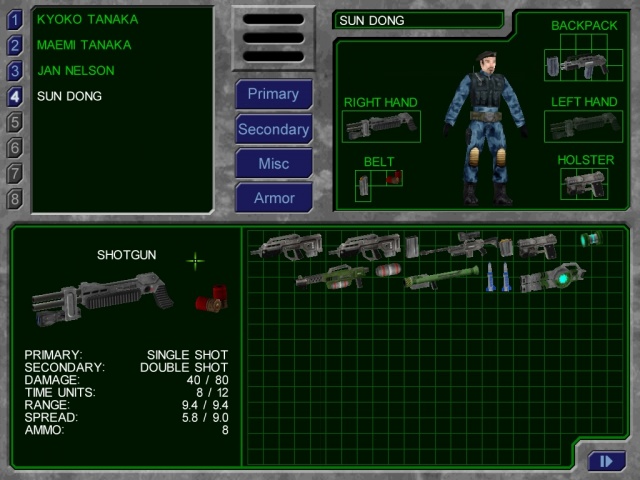
Certain fan made offerings of the familiar XCOM formula have shown just how in depth the strategy layer of the game could be. Multiple XCOM bases, micromanaging squad equipment down to the number of magazines and grenades they can hold, not to mention how many individual rifle mags, napalm tanks, rockets or what have you you’d like to manufacture. Without the finer details for the player to tweak, I feel Firaxis needed to add a few more layers to the strategic depth of the management layer to keep things interesting.
The Open Source, fan-made XCOM equivalent UFO:AI allows for comprehensive squad customisation, down to what items are attached to their belt or crammed in their backpack.

There’s also an apparently large amount of level variations on offer, which I don’t deny, but I have come across the same spaces quite a few times. Unfortunately many of the UFO crash/landing missions are just not as fun to play in as the urban spaces. Larger UFOs in particular are quite daunting to approach. Not because they look particularly menacing but because they often involve many levels, large ramps where it’s impossible to take cover and all sorts of oddly angled walls and items that make line of sight very hard to judge. A lot of time is spent in these levels trying to frustratingly track down the last few enemies, leading you to divide your squad up out of desperation only for your lone sniper to bump noses with a berserker and two elite mutons literally spooning in an extreme corner of the map. It also seems like a bit of a missed opportunity that there aren't at least some culturally themed levels. No oriental looking temples in Asia or shanty towns in Brazil/Africa. I hope that doesn't come off too culturally presumptuous. I just feel like I'm in topsy turvy world when I'm assaulting a Ponderosa steakhouse equivalent in Nigeria. Then again aliens that impregnate you with their offspring through your mouth before eviscerating you from the inside have invaded, so who am I to say what’s weird.

I feel there are some missed opportunities when it comes to the little details too, specifically with regards to the base commanding part of the game. Like how if I have multiple laboratories stacked next to each other (as is encouraged by the game for research benefits) they all very obviously look the same while each of them have scientists standing in the exact same spots with the exact same animations. Soldiers in the barracks are always either on a treadmill or sitting at the bar, I never get to see them bonding over that pool table in the mess room or grabbing some shut-eye. Hell why not have a shooting range where they can blow off some steam? Better yet, every once in a while have one of them visit the memorial as they sit and remember the fallen. You've made me care about my little comrades this much Firaxis, why not go that extra little step? I know what you’re thinking, small complaints and there are better things to spend time on I suppose. But a self-entitled wannabe-dev can dream.

I suppose I should go face that Ethereal now. Shit.

Tuesday, November 6, 2012

Death - The Architect of Passage


After power scrolling through the updates of my twitter crushes I came across an apparently aged article written by Christian McCrea, a previous games tutor of mine. As he states himself, McCrea weaves in and out of ideas a little too haphazardly for me to fully understand the broad stroke of his argument, but there were pockets of thought enclosed that triggered something within me, enough to want to form my own musings on similar subjects he mentioned. His paper can be read here.

The primary sticking point for me was McCrea’s statement on how we ‘gain pleasure from bodily exhibition, not dissimilar to a waxwork museum’. I am not entirely sure if this is something the minority experience, perhaps most viewers and players do; but there seems to be a morbid fascination and even beauty to the end-state of a life. Why else are we so bedazzled by flying limbs and corpses pushed to or from their physical extremities after an explosion or a shotgun blast? Maybe it is a fascination with dance like movements as rag dolls somersault and spin through the air, or perhaps it’s the wonder of what someone looks like when they are shot and slam against a wall, or maybe we just like to admire any kind of airborne object. Maybe it’s all three? When the main draw of this medium is its interactivity, then the process of how a user chooses to play and eventually ends a life is one of the most empowering moments within the matrix. The entire process of an in-game kill is influenced by a player, from what weapon we use, where we place the bullet/explosive and if one is perceptive enough, what kind of environmental feature the enemy will land on for maximum artistic effect. I am tempted to call the entire process itself an art, more so in a similar respect to how a traceur effortlessly glides across a cityscape. In a way, a player who has mastered the mechanics and ‘feel’ of a game reflects this artistic flow and mastery of system and self as he plays.


“The body, animated and otherwise, is the concentration point of game materiality – where the senses are interfacing most often, and where most of the production system is oriented. In cases where these bodies disappear soon after death, an evaporation of visible labour occurs.”

McCrea rightfully states the importance of the animated and ‘lifeless’ game body when we interact with it and here I’d like to briefly point out their importance. A distinct peculiarity and personal annoyance I find in some games is the abnormality of the disappearing dead body. Perfectly understandable from a technical standpoint and I know why it is sometimes necessary, but in certain games the visceral reality you've allowed your mind to immerse itself within comes crumbling down under such circumstances. As McCrea states: 

“Bodies left by the player are not murder victims, but our symbolic architecture of passage, leaving place where space once stood. In each game text, if we are to speak of specificity, a different context of memorialisation through the corpse’s lack of animation is true in each game, and in each gameplay.”

Dead bodies in a game area are an integral part of the world’s architecture as much as if the level was to stand on its own as an art piece. I'm not trying to say that the inside of a digital Vatican littered with bloody bodies is ‘art’, that is not the point I am trying to make by any means. But dead bodies left behind by a player are an important sense of passage, of how the player has chosen to touch upon the world. This is what the medium is all about. When a player blasts through a corridor leaving a trail of dead bodies only to turn back and observe that they have faded away, forgotten and abandoned by the system; that is to deny the essence of a character’s actions and of sense of place and purpose. It’s to deny Max Payne’s relentless path of vengeance, Bill and Zoe’s last desperate push for survival through a sea of zombies or the intensity of Adam Jensen’s attempt to save a crash landed friend from an onslaught. Important decisions had to be made and intense moments had by the player in all these circumstances. The game had better damn well of remembered that.


You see the bad-assery that unfolded here? Those 3 unconscious heavily armed guards?Yeah no it wasn't New Years. THAT WAS ME. These bodies, this image, tell a several hundred word story that one would scantly believe had it been a sterile corridor.

The more a game does to remember player choice, the more gratifying the player’s passage through space and narrative. For this reason I congratulate Rockstar on their ever-improving Euphoria Tech. When animation is one of the primary hurdles to immersion in an otherwise spectacularly and believably crafted vision, the reactivity of NPCs clenching their abdomens in pain or the writhing of near-corpses after being shot indiscriminately in the scrotum, is the saving grace of the virtual reality. If you must, take away my inanimate clumps of polygons off screen. But know that you lessen this player's experience when you do.

Monday, July 23, 2012

From Dust till Lawn


The following was a one page review I was required to write for a Quality Assurance job application I did a few months ago. I haven't heard anything back since, but no matter. After recently replaying the game momentarily I re-read this review and still agreed with everything I had previously written. Thought it was worth posting after a month of inactivity. Voila.

A review of Eric Chahi’s and Ubisoft Montpellier’s ‘From Dust’

‘God games’ are few and far between these days and it seemed like From Dust would satiate that craving for creationism. However building houses and amenities for your dedicated followers and cultivating their existences is not what this game is about, despite the expectancies the likes of Black & White and Populous may have predisposed us to.

Essentially From Dust is a puzzle game where the main tool for solving the problems presented to the player is a rather advanced environment physics simulator. The player controls an aptly named omniscient being called ‘The Breath’. Appropriately named since the world is slowly and subtlety altered by you, rather than instantly and profoundly shaken by a single mouse click. Every world’s overarching objective is to populate a number of totems on the map which then opens a portal to the next world. Sounds like a simple objective, but one that is difficult to attain when the unforgiving forces of Gaia are unleashed upon you.

You have the freedom to terraform the world however you please in order to protect your tribesmen and guide them to the objectives. Earth, water, lava and other peculiar plants can be manipulated as you please. However there often isn’t as much freedom in how you solve the numerous hurdles the game presents. The game largely expects you to solve its puzzles the way it wants you to solve them. The lack of lateral thinking required is disappointing. Despite how often pre-determined the answers to the puzzles feel, the levels are designed superbly in a way that subtly conveys to the player the recommended solution. For example: dry, rocky river beds near flowing water often hints that you should redirect the water flow towards them.

Nature is unpredictable and it is entirely possible for your carefully crafted stream to suddenly turn into a rushing river, perhaps unexpectedly drowning your poor tribesmen. Some thought definitely has to be put into how you change the environment, as the slightest misplacement of earth could end up changing the landscape entirely. Taking earth from one spot may reveal a water source that can start a rushing river thereby changing the landscape and the nature of the problem you were trying to solve completely. It is in moments like this where From Dust can be the most fun, when you are forced to think and react quickly with the resources available to avoid Mother Nature’s wrath.

For a game about the beauty and merciless nature of the environment, From Dust is suitably pretty. Watching a dusty desert spring to life with rolling grass, palms and wildlife is so immensely satisfying. It is just unfortunate there is no equally profound change in how the game is actually played when this happens (besides unlocking a new tribal ‘memory’ i.e. a paragraph of story flavored text). Though I can accept the game’s focus is that of its environmental physics system, some sort of deeper establishment between the player and the actual ecosystems you have created would add another interesting aspect to the game rather than simply shifting elements around. The same routine of claiming totems and entering portals every level also gets stale. But at least the methods to which you succeed towards these objectives are varied enough in every world to keep the game interesting.

That said From Dust knows its strengths and where its focus lies. What it does focus on, its superb landscaping simulation, is immensely satisfying to sculpt with. Whether you’re playing purely to answer the ‘what if’ scenarios you conjure in your mind or if you’re trying to guide your tribesmen to salvation, From Dust is a triumph in logical puzzle solving through environmental simulation. 

Saturday, June 23, 2012

A History of ViolEnc3


E3 has come and gone and left us with a trail of assorted shooters, shootem-ups and shooteries. You know what Spiderman used to say: With great shooters comes great amounts of copious violence (something along those lines); and it is in this scape of never ending bloody releases that I wish that phrase was closer to what Spiderman actually said. That is: With great shooters comes great responsibility. I wish devs would cling on to words akin to this as if their own dying uncles were laying in their arms exhaling a final addendum to a history of good, fatherly, gamey advice such as: ‘Don’t put an un-skippable cut scene right after a frequently reloaded checkpoint’ and ‘Quick time events are bad’. Mind you none of these loudly complained about ideas seem to permeate through the apparently thick walls of many design meetings.

Call me a new-age indie hippy gamer, I don’t care. But I feel like we’ve been rinsing and repeating the same formula since 1992. When I glance over a few pages of comments left behind by our dearest youth after watching a Far Cry 3 E3 demo on Gametrailers, I die just a little bit on the inside. “GOTY!”, “Ubisoft is the best!!1”, “This is one of the bst things ive evr seen.” These comments make me sad and all this commotion for what? Because we can run around a titillating tropical island, stab people from under water, approach an objective stealthily but then have the effort it took to sneak around not even matter because two minutes later a scripted event will trigger a manhunt on you anyway, oh and now you can chain together knife kills. I am all for anything that adds to the diversity of a typical shooter experience, from what I have seen Far Cry 3 implements these new systems and more rather well. In fact I will more than likely have a blast playing it. I know what you’re thinking reader, ‘So what’s the deal idiot? Why are you complaining?’

I want to be challenged by the encroaching prospect of death in a game; whether it is me at the end of another’s shotgun, someone at the end of my shotgun or the end of another’s shotgun being forced into the face of another poor sod. I do not mean the challenge of whoever has the quickest reaction time to pull the trigger. I mean the challenge of having to handle the weight of responsibility and the consequences of my actions or inaction. ‘Consequences’ is a heavily loaded word thrown around at many a press conference and interview alike; and usually the end product does not superbly represent the profoundness or complexity of what was promised. Bioshock would be an elementary example of the whole ‘choices and consequences’ mantra. Choosing to kill or free a little sister is hardly the deep choice the game makes it out to be. The results are purely physical – numerical; the after effects of your game shattering decisions being extra resources or fewer resources followed by a binary good or evil finale.

The Deus Ex games are great examples of profound consequences through player actions and choices; down to the most minute and seemingly unimportant decisions the player makes. For example: You and your brother Paul are under attack in an apartment room. Paul tells you to leave out the back window so you can escape unharmed, he doesn’t leave you any other options. What the game doesn’t tell you and what many players do out of pure empathy for Paul, is that you can stick around and fight it out with him until you are eventually captured. Both situations will result in your capture, but leaving the apartment means your brother will die alone to a sea of enemy agents. Battling it out with him means he will actually survive; which the player only finds out an hour later into the game. Paul will then continue to be a reoccurring character throughout the game. The player’s decision to fight or flight in the face of Paul’s death is crucial to the evolving narrative. It’s situations like this, where there is profound consequence, which I wish had more precedence in shooters these days. After all what makes games such a unique medium is the opportunity to weave mini narratives for ourselves or affect broader strokes of the story.

It seems the only game at the show that dared to differ from the normal sea of somewhat senseless violence was Naughty Dog’s The Last of Us. What was shown during the gameplay presentation was hopeful. It appears to be an action-adventure much in the same vein of Uncharted, albeit a more tense and gradual experience. What I found most impressive was that the enemies the protagonist and his young sidekick were disposing of were not just blank slate baddies simply present for our murderous enjoyment. These ragged men were quite clearly individuals driven to desperation given the post-apocalyptic setting and it showed; through their facial expressions, their actions and especially through their voice acting. These men are so intent on killing you, yet when put in life compromising situations they showed more human emotion than any NPC I had ever seen in a game. When using one as a human shield he suddenly beckons the player to be calm: ‘take it easy, take it easy’. But the end of the demo was most striking when a smothering competition turns against the AI opponent. He starts pleading for his life: 'NO DON'T! -' but not before he receives a prompt load of shotgun pellets to the face.

I wonder what would happen in the final build if I were to let that last enemy live. I’m going to assume if I did he would simply start swinging at me again as you walk off, but I hope I’m pleasantly proven wrong. I hope there is either a benefit or ramification for letting that guy go after he tried to strangle you to death. Even if their isn’t though, it is still refreshing and wonderful to know that the AI at the end of my iron sights has been crafted with the depth and emotion of a human; that he fears death just as much as I do as a player and as a living entity. What I saw in that demo was a breath of fresh air and hopefully representative of how all of the AI (or the humans at least) will react and behave in encounters, hopefully with some personal accountability thrown in there as well.

Friday, May 18, 2012

A Bastion of Style Over Substance


Kid isn’t sure how he should start his next blog post on his own 2 bit website. Doesn’t wanna start it off like a typical IGN article, thinks imitating the game’s narrator is creative.

Kid struggles to find a Segway. But it’s okay, no squirts’ll be reading this for a while.

It’s easy to see Bastion’s presentation through its narrator to be a pretentious affair. A sultry, subtle southern voice that’s maybe been forced out a little too deep for the voice actors liking. Rucks is his name, in Bastion that is. He’s grating sometimes, but his vocal omnipresence never becomes a strain on the convexities.  Its more what he says that is pleasing to hear rather than what he sounds like, at least from the viewpoint of an intrigued gamer such as myself.

Pretentious I said, but so unique and charming that it doesn’t even matter. Rucks is a  brilliant way to present character and setting exposition when there are no characters to speak to, no texts to read. Unlike Dragon Age for example, admittedly a much deeper universe that is littered with thousands of words in codex entries and character dialogue that attempts to explain the physicality of the world. It’s hard to escape the grasp of forced exposition, but in a game such as Dragon Age it is to be expected. Conversely, Bastion is refreshing in how it allows you to maintain the action while soaking in the deeper meaning of on-screen events and the substance of the world.

This is no passive voice that bludgeons you repeatedly with random and obvious factoids either, well… maybe sometimes. But Rucks is so active in telling his story to the detail. Perhaps I decided to use one weapon or ability over another, perhaps I fell over the edge of the level one too many times, or maybe I like to eviscerate every piece of interactive object in a level. Rucks will tell it like it is depending on whatever it is you do. In my thought process it almost acts like a reward. ‘Thank you game, for allowing me to use the shotgun instead of the bow; but thank you also for acknowledging my play style with your sultry man voice.’ As a result no matter how repetitive the action can become sometimes, there is always Rucks to provide something different, something extra. I actually want to play the extra-curricular challenge rooms (or ‘proving grounds’) because I know he’ll have something interesting to say and then some. Whether it’s about the history of the place or to comment on the Kid’s perseverance.

Whether the narrator as a character himself has any non-linear sway over the actual events or ending of the game, I’m not sure of yet. In Prince of Persia: Sands of Time, the narrator is the player and the prince himself; but he knows the eventuality of the story. On the other hand take The Stanley Parable, where the narrator’s hand is forced by the player’s actions whether the player decides to be obedient or not. I haven’t completed the game yet, so it’s unclear to me whether Rucks has good intentions or autonomy over the plot. We’ll see.

Bastion’s style oozes from its narration, but more so from its art direction and music. It is a world with no shortage of extravagant colours and cluttered mess. As the player, The Kid, traverses along pathways, the space beyond him is unknowable; but not for long. Tiles and set pieces fall into place around him as he pushes onward, ever so faithful he must be that a pathway will actually reveal itself to him from the stratosphere. It is so unlike anything I’ve ever laid eyes upon before. It has the color palette and the feel of an overly high fantasy setting, yet looks nothing like your typical fantasy setting. The music totally follows this trend, mixing and blending middle-eastern with western acoustics and synths. Utterly unique.

Utterly unique probably isn’t what you would describe Bastions gameplay systems. This is in no way a terrible thing though. The combat is perhaps best compared with Diablo or any similar action-RPG. There is a decent selection of weapons, all unique from each other and some with alternate fires. Melee or ranged or even both, take your pick; you’ll find yourself amidst different groups of enemies wishing you had a different load out while at other times you’ll pat yourself on the back. There is no ‘wrong’ way to play. A shield adds defensive capabilities and timing your blocks just right will counter your enemy’s attacks, especially satisfying to pull off in the midst of chaotic combat. A fairly vast selection of special abilities, upgrades and even halo-like ‘skulls’ are all available to flavor the action.

Annoyances are minor compared to the overall experience but make themselves known very often, especially on PC. You’ll find yourself trying to balance on extremely narrow paths with one misstep leading to death on either side. Walking diagonally and accurately on a plank is not easy on a keyboard and is a clumsy elementary experience. Additionally the ground beneath you often likes to conveniently collapse as much as it likes to conveniently appear. It’s great for adding tension and challenge, but there were a couple of times where I’d be stuck on an isolated tile whilst being attacked by a floating enemy, leading to repeated death with almost no escape. It’d be nice if the Kid could respawn on the main landmass not three centimeters away. Occasionally the Kid will fall into the abyss below when you could have sworn he was quite clearly on solid ground or just skirting it.  

That’s all for now. I hope to finish the game soon and update the blog with another entry. Moving houses doesn’t allow for a lot of game time.